
Welcome to the Mathematical World!
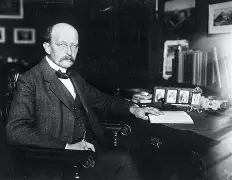
Max Planck
Father of Quantum Theory
Max Planck (1858–1947) was a German theoretical physicist who originated quantum theory, fundamentally transforming our understanding of atomic and subatomic processes. Born in Kiel, Germany, Planck showed early promise in mathematics and physics, eventually studying at the University of Munich and the University of Berlin under Hermann von Helmholtz and others.
Blackbody Radiation and the Ultraviolet Catastrophe
In the late 19th century, classical physics could not explain the spectrum of light emitted by a heated object (blackbody radiation), particularly at short wavelengths — a problem known as the ultraviolet catastrophe. Planck solved this problem by proposing that energy is quantized, emitted, or absorbed in discrete units called quanta.
He introduced the fundamental relation:
\[ E = h \nu \]Where \( E \) is the energy of a quantum, \( \nu \) is the frequency of radiation, and \( h \) is Planck’s constant (\( 6.626 \times 10^{-34} \, \text{J·s} \)).
Planck’s Radiation Law
Planck derived a formula describing the intensity of radiation from a blackbody at temperature \( T \):
\[ B(\nu, T) = \frac{8 \pi h \nu^3}{c^3} \frac{1}{e^{h\nu/k_B T} - 1} \]Where \( c \) is the speed of light, and \( k_B \) is Boltzmann’s constant. This law agreed perfectly with experimental data and laid the groundwork for quantum mechanics.
Quantum Theory
Planck’s radical idea — that energy is quantized — challenged classical physics, but it became the cornerstone of quantum theory. He did not initially understand the full implications, but his work paved the way for Einstein, Bohr, Heisenberg, and Schrödinger to develop modern quantum mechanics.
Later Work and Legacy
Planck also made contributions to thermodynamics, particularly the second law, and was an influential teacher and mentor to many future physicists. He received the Nobel Prize in Physics in 1918 for his work on blackbody radiation.
Max Planck’s introduction of quantization changed the course of physics forever, marking the transition from classical to modern physics and influencing virtually every branch of 20th-century science.

All rights reserved by the Mathematical Unity
Contact: +8801400044645
Email: mathematicalhorse1453@gmail.com
Our Discord Server: Mathematical Unity [Ulus Riyadiyat]